
Single Drum Rotary Dryer for Coal Slime, Clay & High-Moisture Materials
Single drum rotary dryer for high-moisture, sticky materials — coal slime, clay, sludge and minerals, 25-90 t/h. Anti-sticking flights, adjustable residence time, high stability. Get a quote!
Product Details
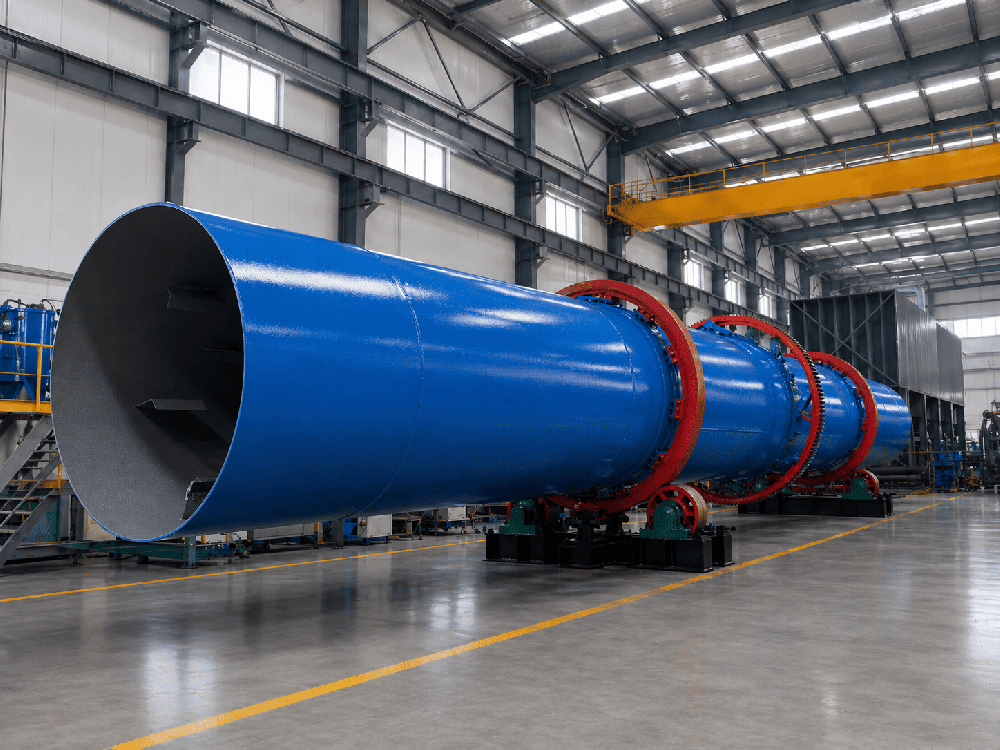
A single drum dryer (single drum rotary dryer) is a horizontal rotating cylinder that dries wet material by bringing it into repeated contact with hot gas. Lifting plates inside the drum shower the material through the hot air while it slowly moves from the feed to the discharge end. Because of its simple, long drum and flexible flight designs, the single drum dryer is especially good at handling high-moisture, high-viscosity or lumpy materials such as coal slime and clay, and it is widely used in building materials, metallurgy, mining, environmental and foundry industries.
What Is a Single Drum Dryer?
It consists of one slightly inclined steel drum mounted on support rollers and turned slowly by a drive. Wet material enters the upper end; as the drum rotates, lifting plates pick it up and shower it through hot gas supplied by a burner (co-current or counter-current). The dried material leaves at the lower end and the exhaust gas passes through dust-collection equipment. Drum speed, flight type and residence time can all be adjusted to suit different materials.
How It Works
Feeding — wet material enters the rotating drum through a feeder;
Lifting and showering — flights repeatedly lift and drop the material through the hot gas for even heat transfer;
Forward movement — the inclined, rotating drum carries the material toward the discharge end;
Drying — hot gas evaporates the moisture; sticky feeds use knockers, chains or anti-sticking plates;
Discharge and dust control — dried product exits the hood and exhaust gas is cleaned by cyclone / bag filter.
Structure and Main Components
Rotating drum (shell) — inclined cylinder with lifting plates and wear liners;
Lifting plates / flights — various shapes, with knockers or chains for sticky material, form an even material curtain;
Riding rings, support rollers and thrust rollers — carry and align the drum;
Drive unit — motor, reducer and girth gear;
Burner and hot-air duct — supply hot gas, co-current or counter-current;
Feed/discharge hoods with seals — control material and air flow;
Dust collector — cyclone and/or bag filter clean the exhaust.
Single Drum vs Triple Pass Dryer
Single drum — a long, simple drum with flexible flights, knockers and anti-sticking devices handles high-moisture, high-viscosity or lumpy material (coal slime, clay) well, at lower cost and with easy maintenance; it is longer and uses more floor space and fuel;
Triple pass — three nested drums reuse heat for about 30–40% lower fuel use and a compact footprint, best for free-flowing sand, but less suited to very sticky, lumpy feeds.
Choose the single drum for sticky, high-moisture material and flexible operation; choose the triple pass for sand where space and fuel are critical. See the triple pass rotary dryer.
Materials and Applications
The single drum dryer handles high-humidity, high-viscosity materials including coal slime, sludge, clay, bentonite, lignite, fly ash, slag, foundry sand, iron and titanium powder and various mineral fines. It serves the building-materials, metallurgy, environmental, mining, petrochemical and foundry industries.
Key Advantages
Combined lifting plates form a uniform material curtain for full heat exchange, with anti-sticking designs and adjustable residence time;
Self-aligning support rollers give linear contact with the riding ring, reducing wear and raising stability;
Optimised drive and drum speed reduce power consumption and keep the shell running smoothly;
Anti-sticking and vibration devices handle high-viscosity material without build-up;
Low-air-speed tail hood and wear-resistant seals reduce air loss and improve dust collection;
Long service life, high reliability and easy maintenance.
How to Choose / Sizing
Select by capacity, initial and final moisture and material viscosity. The standard range covers drum diameters from 2.5 to 4 m and capacities from about 25 to 90 t/h:
Φ2.5×22 / Φ3×20 for 25–40 t/h — small and medium duties;
Φ3.2×32 / Φ3.6×36 for 40–70 t/h;
Φ4×40 for 70–90 t/h — large lines.
For slime and sludge, inlet moisture can reach 30–40% with final moisture around 15%; for ordinary material inlet is typically 10–26% and final about 1%. Send us your material, capacity and inlet/target moisture and we will size the dryer, including burner, feeder and dust collection.
Related Equipment
Product Specifications
| Specification | Φ2.5×22 | Φ3×20 | Φ3.2×32 | Φ3.6×36 | Φ4×40 |
|---|---|---|---|---|---|
| Outer Cylinder Diameter (mm) | 2500 | 3000 | 32000 | 3600 | 4000 |
| Outer Cylinder Length (mm) | 22000 | 20000 | 32000 | 36000 | 40000 |
| Cylinder Speed (r/min) | 3-10 | 3-10 | 3-10 | 2-5 | 2-5 |
| Initial Moisture Content | 10-26% (coal slime 30-40%) | ||||
| Final Moisture Content | 1% (coal slime 15%) | ||||
| Maximum Inlet Air Temperature (°C) | 750-1000 | 750-1000 | 750-1000 | 750-1000 | 750-1000 |
| Production Capacity (t/h) | 25-35 | 30-40 | 40-50 | 50-70 | 70-90 |
| Motor Power (kW) | 37 | 55 | 90 | 110 | 160 |
NOTE: Capacity figures are based on general throughput of medium hardness materials. Actual performance may vary depending on feeding size, rock types and water content.
Installation & Service Process
Foundation Drawing
Within 3 days after signing
Professional engineers provide customized foundation drawings based on your site conditions.
Installation & Commissioning
10-15 days
Two experienced engineers provide on-site installation guidance and equipment commissioning.
Operator Training
2-3 days
Comprehensive training covering both theory and hands-on practice for your team.
After-Sales Support
24/7 Technical Support
- Video diagnosis within 2 hours
- Spare parts dispatched within 48 hours
- On-site engineer within 7 days (major countries)
Frequently Asked Questions
What after-sales support does ZZZC Group provide?
What capacities and specifications are available?
ф2.5×22 m
ф3×20 m
ф3.2×32 m
ф3.6×36 m
ф4×40 m
What are its key performance advantages?
Efficient Drying: Custom-designed lifting blades create a uniform material curtain for maximum heat exchange.
Anti-Sticking & Anti-Crushing: Vibration devices prevent sticky materials from clumping, while internal devices minimize particle breakage.
Dust Control: A tail hood design is tailored for different materials to reduce wind speed and improve dust removal.
Energy Saving: Its optimized roller design reduces power consumption by over 30%, contributing to lower operational costs.
What types of materials is the single-drum dryer designed to handle?
What is a Single-Drum Dryer and how does it work?
Related Products


Get a Quotation
Please fill in the form below (* are required) to send us a brief message, we will reply to you within 12 hours/provide you with the latest quotes.
SERVICE PROMISE
Senior technical engineers provide you with customized solutions and professional installation services to effectively solve your problem in after-sales.