
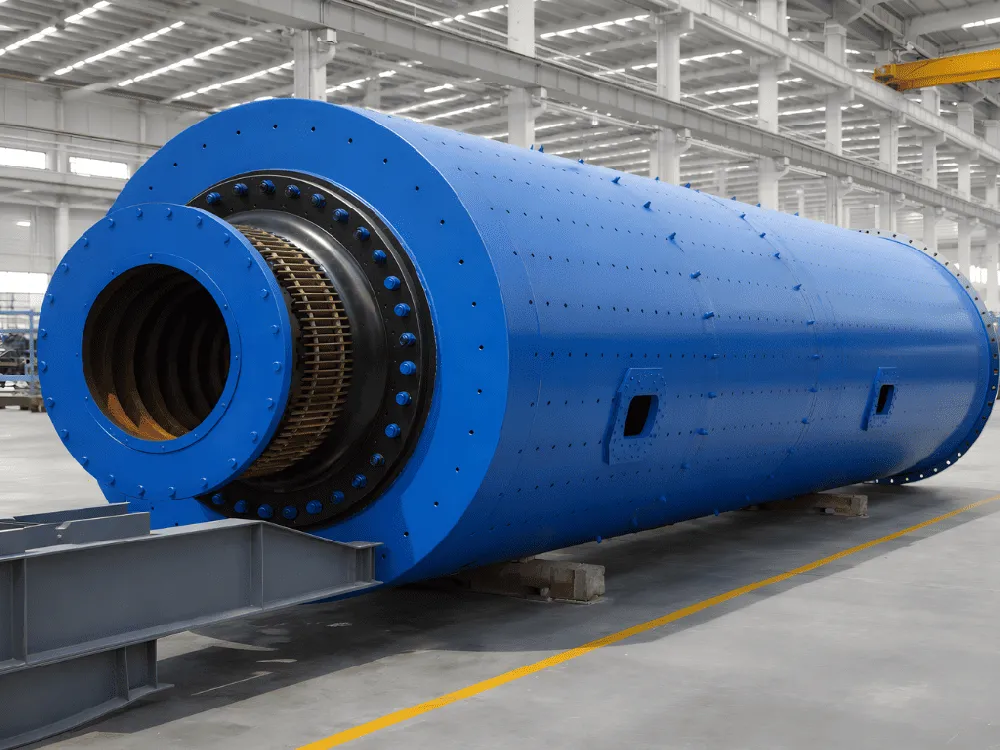
Cement Ball Mill | Finish & Raw Grinding
Cement ball mill for finish grinding and raw material grinding in cement plants - also for metallurgy, chemical and power industries. Durable, high output. Get spec and price.
Product Details
Ultrafine cement ball mill is not only suitable for processing cement raw materials and clinker, but also for ultrafine grinding of various industrial waste residues such as fly ash, mineral powder, steel slag, bottom slag, vanadium titanium slag, etc. It is also suitable for grinding various ores and other grindable materials in industrial and mining enterprises such as metallurgy, chemical industry, and electric power. It can be used for open flow grinding, and also for circulating ring flow grinding composed of powder selector.
Advantages
1. High yield rate, durable, smooth operation, reliable performance, good wear resistance, and can be freely adjusted according to needs;
2. New wear-resistant lining, greatly improves the life of wearing parts and reduces operating costs;
3. Simple process, easy to operate, extremely low maintenance cost, and more stable operation;
4. Wide range of applications, large processing capacity, and obvious advantages of continuous operation;
Main components
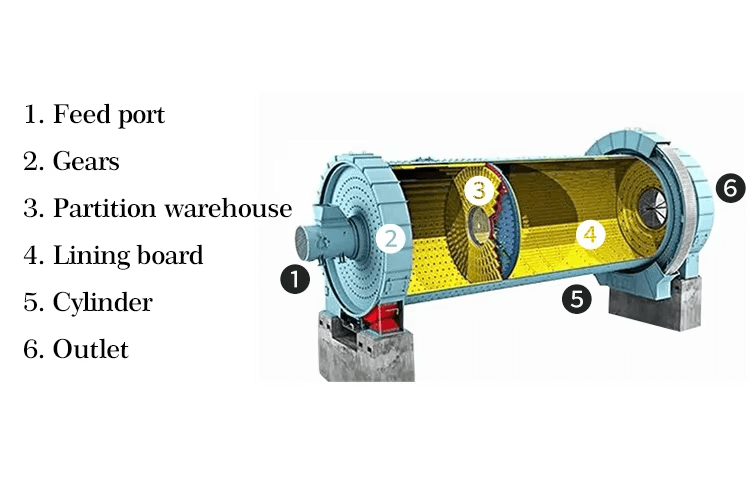
Product Specifications
Model (m) | Grinding medium load(t) | Speed (r/min) | Capacity(T/H) | Power(kw) |
| Φ1.2*4.5 | 5 | 30.3 | 1.4-2 | 55 |
| Φ1.5*5.7 | 11 | 26.34 | 3.5-5 | 130 |
| Φ1.83*7 | 20 | 24.5 | 6.5-10 | 245 |
| Φ2.2*7 | 30 | 21.4 | 8-12 | 380 |
| Φ2.2*13 | 55 | 20.3 | 16-20 | 630 |
| Φ2.4*7 | 36 | 20.4 | 14-16 | 475 |
| Φ2.4*13 | 66 | 20.3 | 25-27 | 800 |
| Φ2.6*13 | 80 | 19.1 | 27-32 | 1000 |
| Φ3*13 | 90 | 18.1 | 33-37 | 1250 |
| Φ3.2*11 | 103 | 18 | 35-45 | 1400 |
| Φ3.2*13 | 126 | 17.2 | 45-53 | 1600 |
| Φ3.8*13 | 170 | 16.3 | 60-62 | 2500 |
| Φ4*13 | 202 | 15.95 | 55-68 | 2800 |
| Φ4.2*13 | 224 | 16.3 | 85-87 | 3150 |
NOTE: Capacity figures are based on general throughput of medium hardness materials. Actual performance may vary depending on feeding size, rock types and water content.
Installation & Service Process
Foundation Drawing
Within 3 days after signing
Professional engineers provide customized foundation drawings based on your site conditions.
Installation & Commissioning
10-15 days
Two experienced engineers provide on-site installation guidance and equipment commissioning.
Operator Training
2-3 days
Comprehensive training covering both theory and hands-on practice for your team.
After-Sales Support
24/7 Technical Support
- Video diagnosis within 2 hours
- Spare parts dispatched within 48 hours
- On-site engineer within 7 days (major countries)
Frequently Asked Questions
What is the typical capacity of a cement ball mill?
What are the advantages of using a cement ball mill?
What materials can be processed in a cement ball mill?
How does a cement ball mill work?
What is a cement ball mill used for?
What are the main components of a cement ball mill?
What are the main advantages of a cement ball mill?
What materials can be processed in a cement ball mill?
How does a cement ball mill work?
What is a cement ball mill used for?
Related Products
Get a Quotation
Please fill in the form below (* are required) to send us a brief message, we will reply to you within 12 hours/provide you with the latest quotes.
SERVICE PROMISE
Senior technical engineers provide you with customized solutions and professional installation services to effectively solve your problem in after-sales.