
Ball Mill for Cement & Mining | 0.65-256 TPH
Industrial ball mill for cement, ore and minerals - 26 models, Ф900 to Ф3600, 0.65-256 TPH, wet or dry grinding, adjustable fineness. Factory-direct quote from Sinoma.
Product Details
Product Overview
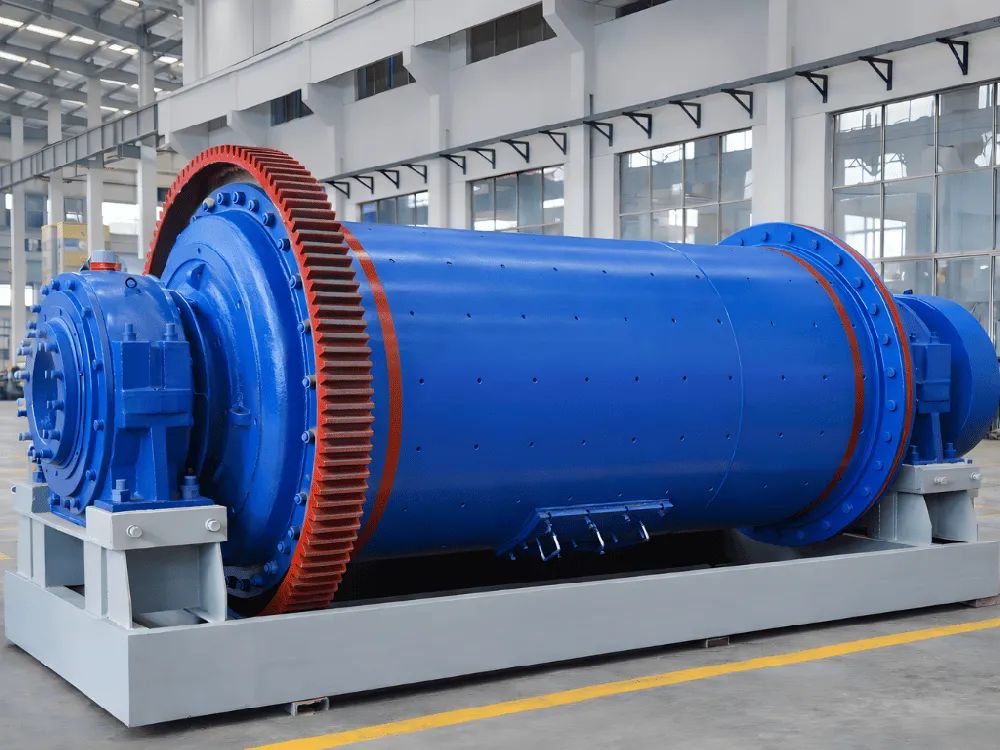
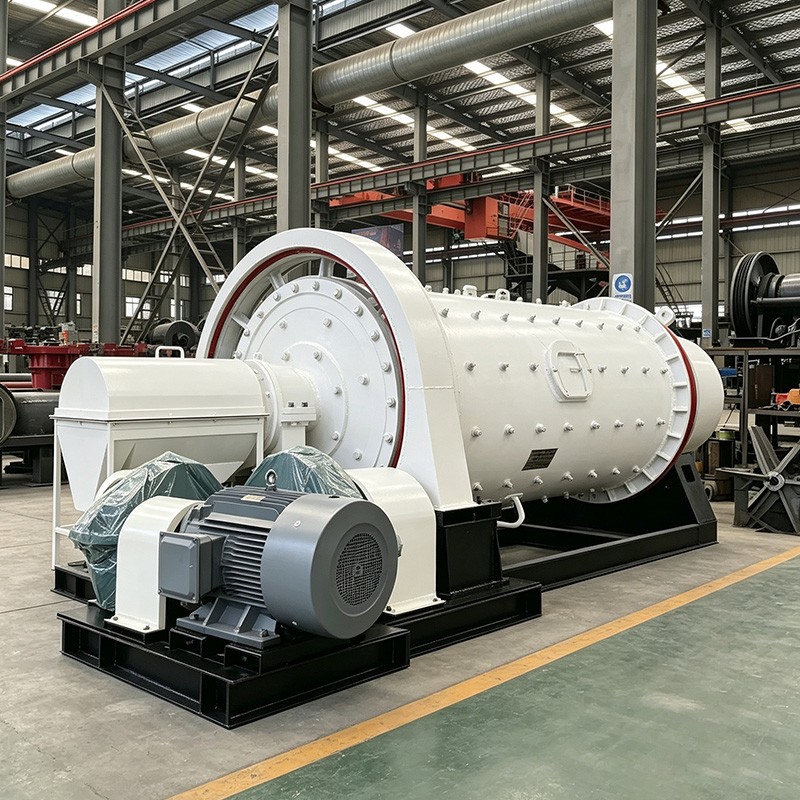
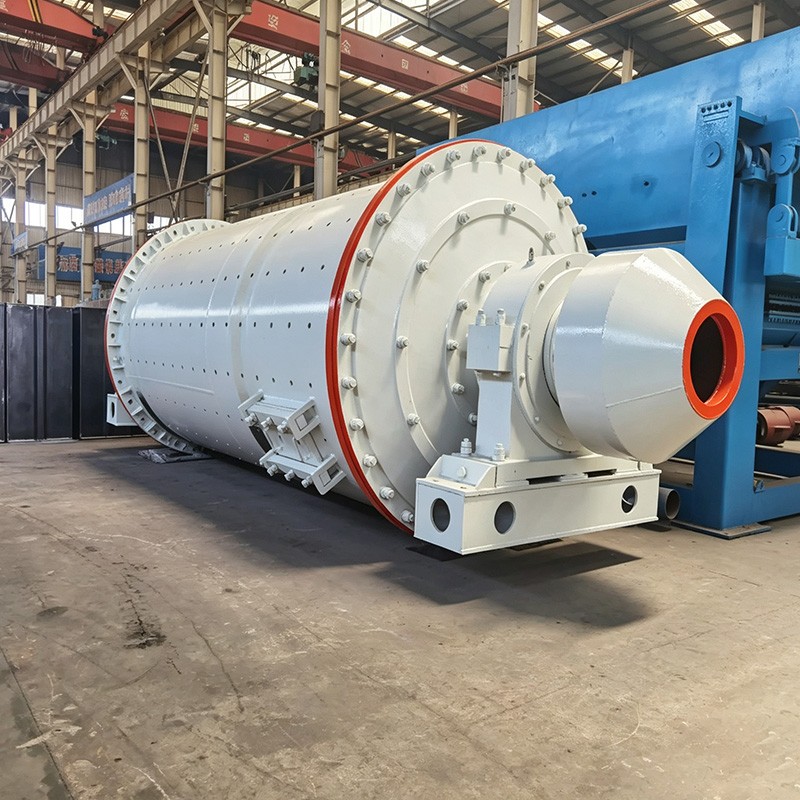
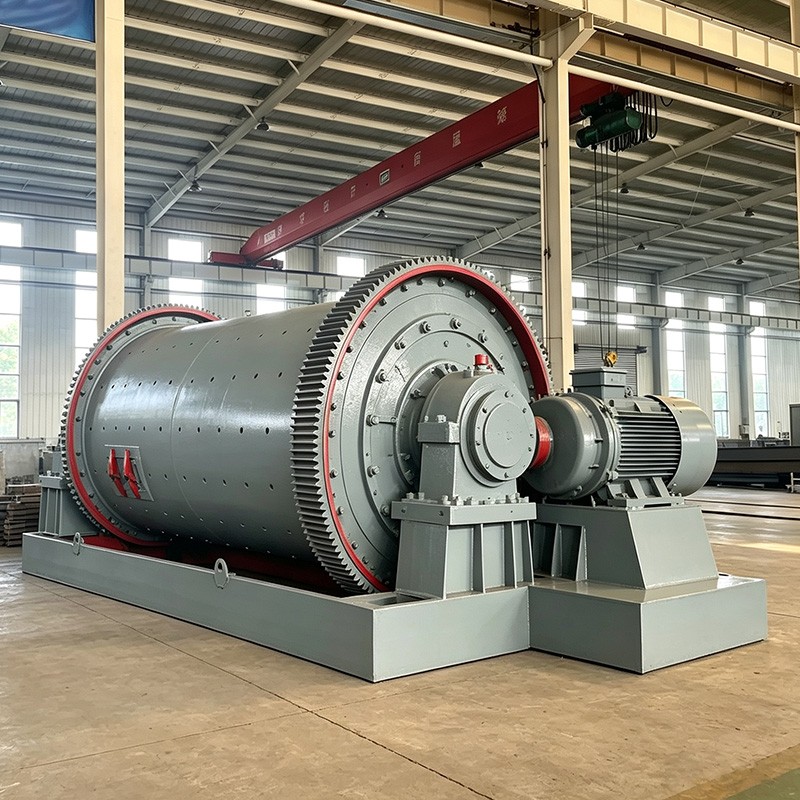
Zhengzhou Sinoma ball mills are heavy-duty cylindrical grinding machines that use forged steel balls as grinding media to reduce crushed materials into fine powder. With 26 models covering shell diameters from Ф900 to Ф3600 mm and capacities from 0.65 to 256 t/h, our ball mills serve cement plants, mining operations, power stations and mineral processing lines worldwide.
Every mill is available in wet or dry grinding configuration, open-circuit or closed-circuit layout (with air classifier or hydrocyclone), and can be tailored to your feed size, moisture content and target fineness.
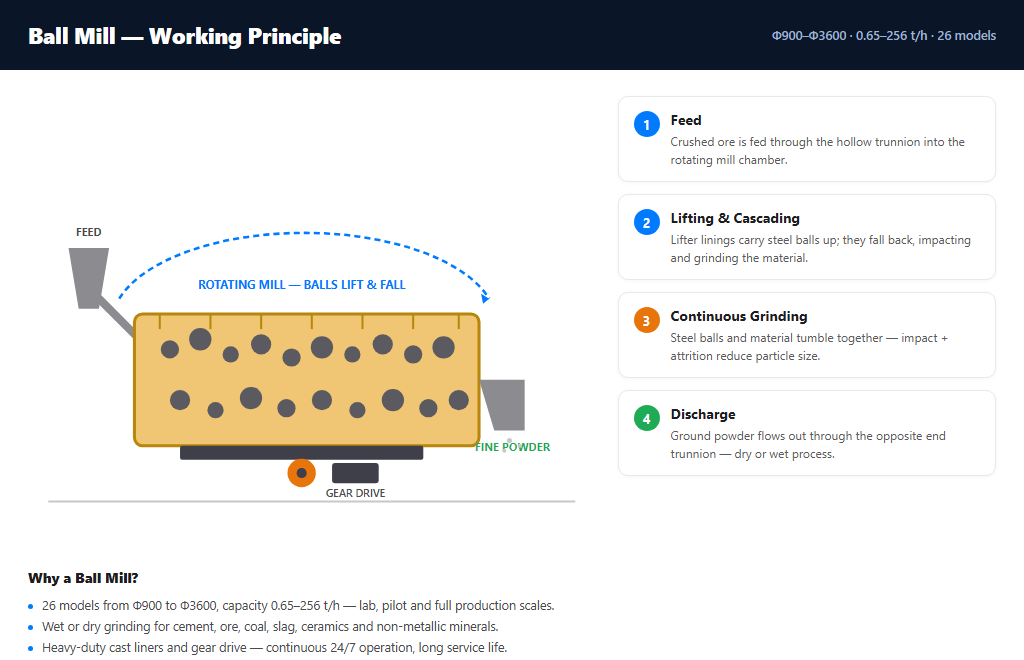
Working Principle
The mill is a horizontal cylinder partially filled with grinding balls and material. As the cylinder rotates on its hollow trunnion shafts, the liners lift the balls to the top of the charge; the balls then cascade down, crushing and grinding the material by impact and attrition. Material enters through the feed hollow shaft, travels through the drum, and is discharged through the opposite end as finished powder, either by overflow or through a discharge grate. Fineness is controlled by rotation speed, ball charge volume, grinding media size and retention time.
Key Features
High grinding efficiency – optimized liner profiles and ball grading deliver stable output with low unit energy consumption.
Adjustable fineness – finished product from 0.075 to 0.89 mm, precisely controlled by media size and grinding circuit configuration.
Continuous 24/7 operation – heavy-duty bearings, sealed lubrication system and wear-resistant liners ensure long service life with minimal downtime.
Wet and dry grinding – one machine family covers both processes; slurry discharge or grate discharge available.
Complete grinding circuit – we supply feeding conveyor, classifier, dust collector and conveying system as one integrated solution, not just the mill.
Factory-direct support – installation supervision, operator training and wear parts (liners, balls, trunnion seals) supplied for the life of the mill.
Applications
Cement & clinker – raw meal and cement finish grinding in 500–5,000 t/d plants.
Mineral processing – ore grinding before flotation or leaching for gold, copper, iron and non-metallic ores.
Building materials – slag, fly ash, limestone and gypsum powder production.
Chemical & refractory industries – fine grinding of silica, alumina, quartz and ceramic raw materials.
How to Select the Right Ball Mill
Selection depends on four parameters: material hardness and moisture, target fineness (mesh), required capacity, and whether you need open or closed circuit. As a rule:
Output below 20 t/h – choose Ф900–Ф1830 series (small footprint, low investment);
Output 20–256 t/h – choose Ф2100–Ф3600 series, optionally with a classifier for finer product.
Send us your material name, feed size, target fineness and hourly capacity – our engineers will confirm the model, recommend the complete grinding circuit, and provide a process flow drawing within 24 hours.
Product Specifications
| Model | Ball loading(t) | Feeding size(mm) | Discharge opening (mm) | Capacity(T/H) | Motor power(kw) |
|---|---|---|---|---|---|
| Ф900*1800 | 1.5 | 20 | 0.075-0.89 | 0.65-2 | 15 |
| Ф900*3000 | 2.7 | 20 | 0.075-0.89 | 1.1-3.5 | 22 |
| Ф1200*2400 | 3 | 25 | 0.075-0.6 | 1.5-4.8 | 30 |
| Ф1200*3000 | 3.5 | 25 | 0.074-0.4 | 1.6-5 | 37 |
| Ф1200*4500 | 5 | 25 | 0.074-0.4 | 1.6-5.8 | 45 |
| Ф1500*3000 | 7.5 | 25 | 0.074-0.4 | 2-5 | 75 |
| Ф1500*4500 | 11 | 25 | 0.074-0.4 | 3-6 | 110 |
| Ф1500*5700 | 12 | 25 | 0.074-0.4 | 3.5-6 | 130 |
| Ф1830*3000 | 11 | 25 | 0.074-0.4 | 3.5-6 | 130 |
| Ф1830*4500 | 15 | 25 | 0.074-0.4 | 4.5-12 | 155 |
| Ф1830*6400 | 21 | 25 | 0.074-0.4 | 6.5-15 | 210 |
| Ф1830*7000 | 23 | 25 | 0.074-0.4 | 7.5-17 | 245 |
| Ф2100*3000 | 15 | 25 | 0.074-0.4 | 6.5-36 | 155 |
| Ф2100*4500 | 24 | 25 | 0.074-0.4 | 8-43 | 245 |
| Ф2100*7000 | 26 | 25 | 0.074-0.4 | 12-48 | 280 |
| Ф2200*4500 | 27 | 25 | 0.074-0.4 | 9-45 | 280 |
| Ф2200*6500 | 35 | 25 | 0.074-0.4 | 14-26 | 380 |
| Ф2200*7000 | 35 | 25 | 0.074-0.4 | 15-28 | 380 |
| Ф2200*7500 | 35 | 25 | 0.074-0.4 | 15-30 | 380 |
| Ф2400*3000 | 23 | 25 | 0.074-0.4 | 7-50 | 245 |
| Ф2400*4500 | 30 | 25 | 0.074-0.4 | 8.5-60 | 320 |
| Ф2700*4000 | 40 | 25 | 0.074-0.4 | 22-80 | 380 |
| Ф2700*4500 | 48 | 25 | 0.074-0.4 | 26-90 | 480 |
| Ф3200*4500 | 65 | 25 | 0.074-0.4 | 30-120 | 630 |
| Ф3600*4500 | 90 | 25 | 0.074-0.4 | 35-160 | 850 |
| Ф3600*6000 | 110 | 25 | 0.074-0.4 | 40-200 | 1250 |
| Ф3600*8500 | 131 | 25 | 0.074-0.4 | 45.8-256 | 1800 |
NOTE: Capacity figures are based on general throughput of medium hardness materials. Actual performance may vary depending on feeding size, rock types and water content.
Installation & Service Process
Foundation Drawing
Within 3 days after signing
Professional engineers provide customized foundation drawings based on your site conditions.
Installation & Commissioning
10-15 days
Two experienced engineers provide on-site installation guidance and equipment commissioning.
Operator Training
2-3 days
Comprehensive training covering both theory and hands-on practice for your team.
After-Sales Support
24/7 Technical Support
- Video diagnosis within 2 hours
- Spare parts dispatched within 48 hours
- On-site engineer within 7 days (major countries)
Frequently Asked Questions
How should a ball mill be maintained?
What are the main advantages of a ball mill?
What materials can be processed in a ball mill?
How does a ball mill work?
What is a ball mill and what is it used for?
Related Products
Related Resources
Get a Quotation
Please fill in the form below (* are required) to send us a brief message, we will reply to you within 12 hours/provide you with the latest quotes.
SERVICE PROMISE
Senior technical engineers provide you with customized solutions and professional installation services to effectively solve your problem in after-sales.